
Table of Contents
Hospital IT teams are under pressure from every direction. Budgets are flat, clinical systems keep growing, and hardware vendors retire server lines faster than many hospitals can migrate their electronic health record (EHR) platforms. Refurbished equipment is an obvious way to stretch capital, but the choice between certified vs uncertified refurbished hardware for hospitals carries consequences far beyond price. One drive that no one properly wiped, or one counterfeit memory module in an imaging server, can trigger a reportable data breach or an outage in the middle of a patient-care shift.
This hospital IT procurement guide explains what “certified” means, where refurbished IT hardware for hospitals makes sense, which vendor certifications to demand, and how to build those requirements into your policy and RFPs. We wrote it for hospital IT procurement teams, clinical engineering staff, and compliance officers.
What Is Certified vs Uncertified Refurbished Hardware for Hospitals?
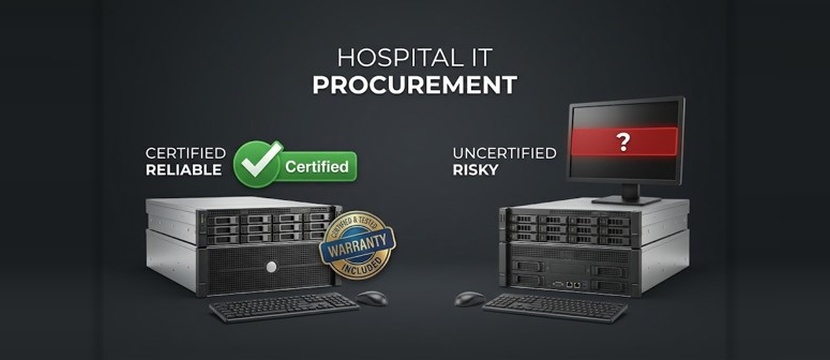
Certified refurbished hardware for hospitals is previously used IT equipment that a qualified refurbisher tests, repairs, sanitizes, and warranties under a documented, auditable standard. Uncertified refurbished hardware is used equipment that sellers offer without verifiable testing, data sanitization records, or meaningful warranty coverage. The difference comes down to process, proof, and accountability.
1. Certified Refurbished Hardware
Either the original equipment manufacturer (OEM) or a third-party refurbisher with recognized industry certifications puts this equipment through a documented refurbishment process. A typical certified process includes:
- Full functional and stress testing (burn-in) of processors, memory, drives, controllers, and power supplies.
- Firmware and BIOS updates to current, supported versions.
- Replacement of worn or failed components with genuine or OEM-equivalent parts.
- Verified data sanitization with a certificate for each storage device.
- A written warranty, often one to three years, with defined replacement terms.
OEM certified refurbished equipment in healthcare typically carries warranty terms close to new hardware. Qualified third-party refurbishers often match those terms at a lower cost.
2. Uncertified Refurbished Hardware
Uncertified refurbished hardware covers auction lots, liquidation pallets, marketplace listings, and gray-market brokers. The unit may power on, but there is usually no test history, no proof of data destruction, no chain of custody, and little or no warranty.
Certified vs Uncertified Refurbished Hardware at a Glance
| Factor | Certified Refurbished | Uncertified Refurbished |
| Testing | Documented functional and burn-in testing | Power-on check at best |
| Data sanitization | NIST SP 800-88 aligned, with serialized certificates | Unknown; no records |
| Parts authenticity | Genuine or OEM-equivalent parts | Risk of counterfeit or relabeled parts |
| Firmware | Updated to supported versions | Often outdated or unpatched |
| Warranty | Typically 1 to 3 years with replacement terms | None or 30 days, “as is” |
| Chain of custody | Tracked from intake to delivery | Not available |
| Fit for hospitals | Suitable with proper policy controls | Not recommended |
Why Are Hospitals Turning to Refurbished IT Hardware?
Refurbished hardware has moved from a stopgap to a strategic option for many health systems. Two pressures in particular are driving hospital IT teams toward professionally refurbished equipment.
1. Cost Savings of Certified Refurbished IT Equipment
Healthcare margins are thin, and IT competes for capital with imaging equipment and staffing. The cost savings of certified refurbished IT equipment are hard to ignore: recertified servers commonly sell for 40% to 70% below equivalent new systems, depending on generation and configuration. Those savings can fund extra capacity, redundancy, or security tooling.
2. EOL Server Replacement in Hospitals
Many clinical and operational applications, including laboratory information systems, PACS, pharmacy systems, and building management platforms, run on specific, validated hardware generations. When an OEM declares a server end-of-life (EOL), moving to a new platform can require costly revalidation or software vendor recertification. For EOL server replacement in hospitals, sourcing identical or compatible refurbished units and spare parts keeps validated systems running while teams plan a controlled migration.
Risks of Uncertified Refurbished Hardware in Healthcare
Uncertified equipment looks like a bargain on a quote, but the hidden risks fall into three categories.
1. Residual Patient Data and HIPAA Exposure
Used drives are a frequent source of data leaks. If an uncertified unit arrives with a previous owner’s data, or if your hospital cannot prove how incoming storage was handled, you inherit a compliance problem. The HIPAA Security Rule requires covered entities to implement policies for the final disposal and re-use of electronic media that contain protected health information (PHI) under 45 CFR § 164.310(d). Hardware with no sanitization record weakens your ability to show those controls exist.
2. Counterfeit and Degraded Components
Gray-market channels are where counterfeit memory, relabeled drives, and recycled processors most often surface. These parts may pass a power-on check and then fail under the sustained load of a busy EHR database or imaging server.
3. No Warranty and No Support Path
When uncertified hardware fails, there is often no advance replacement, no firmware support, and no one accountable. A single unplanned outage, with downtime procedures and delayed results, can erase the savings from buying cheaper hardware.
Compliance Requirements: HIPAA, NIST SP 800-88, and FDA
Buying refurbished hardware does not change a hospital’s regulatory obligations. Before signing a purchase order, confirm how each device supports HIPAA safeguards, NIST sanitization standards, and FDA requirements.
1. Data Sanitization for Certified Refurbished Hardware
NIST Special Publication 800-88, Guidelines for Media Sanitization, is the most widely referenced standard for erasing storage media. It defines three levels, Clear, Purge, and Destroy, and the right method depends on media type and data sensitivity. When buying HIPAA-compliant refurbished servers or drives, require your vendor to:
- Sanitize all storage to at least the NIST SP 800-88 Purge level, or supply new drives.
- Provide a certificate of sanitization listing drive serial numbers, method, date, and technician.
- Maintain chain-of-custody records from intake through shipment.
- Sign a business associate agreement (BAA) if the vendor will handle devices containing your PHI, such as during returns or ITAD.
Keep in mind that no refurbished server is HIPAA compliant on its own. Compliance comes from your hospital’s safeguards, and the right vendor makes those safeguards provable.
2. FDA and Regulatory Compliance for IT Hardware in Hospitals
The U.S. Food and Drug Administration (FDA) does not typically regulate general-purpose servers, switches, and storage as medical devices. The picture changes when hardware is part of a medical device system, such as a server that an imaging vendor specifies. Substituting anything other than the validated configuration can affect regulatory status and support agreements, so confirm with the device manufacturer and your clinical engineering team first.
Vendor Certification Standards for IT Hardware
Certifications give procurement teams an objective way to separate professional refurbishers from resellers. Ask for current certificates and verify them with the issuing body.
- R2v3 (Responsible Recycling): SERI’s standard covering data security, testing, and repair of used electronics.
- e-Stewards: A rigorous reuse and recycling standard with strong data security and export controls.
- NAID AAA (i-SIGMA): A certification focused on secure data destruction, including unannounced audits.
- ISO 9001, ISO 14001, and ISO/IEC 27001: Quality, environmental, and information security management systems.
- OEM Authorization or Partner Status: Confirms access to genuine parts, firmware, and manufacturer support.
Also request sample test reports and references from other healthcare customers.
Refurbished vs New Servers for Hospitals: Where Each Fits
The choice between refurbished and new servers is rarely all or nothing. Most hospitals get the best results by matching each workload to the right type of hardware.
1. Where Certified Refurbished Makes Sense
Recertified hardware is not right for every system, but it delivers strong value in many hospital environments. These use cases offer the best balance of cost, risk, and performance:
- Expanding virtualization clusters on an existing hardware generation.
- Refurbished storage arrays for healthcare imaging archives, backup, and disaster recovery sites.
- Refurbished network equipment for healthcare, such as access and distribution switches in clinics and administrative buildings.
- Spare parts pools for EOL servers running validated clinical applications.
- Development, test, training, and analytics environments.
In each of these cases, pair refurbished equipment with a clear warranty and spare-parts plan so the savings never come at the expense of uptime.
2. Where New Hardware Still Wins
Buy new when you need the latest processor features for AI or advanced imaging, when a software vendor requires current-generation hardware, or when you want the longest service life for a core system. Many hospitals blend both: new hardware for tier-one production and recertified hardware elsewhere.
3. Understanding Refurbished Server Warranty in Healthcare
When evaluating a refurbished server warranty in healthcare, compare warranty length, advance replacement terms, response times, and whether third-party maintenance can extend coverage after the initial warranty expires. Match coverage to each system’s clinical criticality.
Building a Healthcare IT Hardware Procurement Policy
A written policy keeps standards consistent across departments and holds up under audit. It should define approved vendor criteria, minimum certifications, sanitization and warranty requirements, and the workloads that may run on refurbished equipment. The same rules should guide all hospital data center hardware sourcing.
1. Hospital Procurement RFP Checklist for IT Hardware
A clear hospital procurement RFP for IT hardware makes it easier to compare vendors on equal terms and screen out risky offers early. Include the following requirements in every solicitation:
- Required certifications (R2v3, e-Stewards, NAID AAA, or ISO) with proof.
- NIST SP 800-88 sanitization and serialized certificates for all storage.
- Documented testing and burn-in reports for each unit.
- Genuine or OEM-equivalent parts with authenticity guarantees.
- Minimum warranty term and advance replacement SLA.
- Firmware and security patch status at delivery.
- Willingness to sign a BAA and documented chain-of-custody procedures.
- Healthcare references and lead-time commitments for EOL parts.
Remove any vendor that cannot meet these requirements in writing, no matter how attractive its pricing looks.
2. Government vs Private Hospital IT Procurement
Public and government hospitals usually follow formal competitive bidding rules, and federal facilities also follow the Federal Acquisition Regulation (FAR) and requirements such as Trade Agreements Act (TAA) compliance. The solicitation must explicitly allow refurbished hardware. Private hospitals have more flexibility to negotiate directly or buy through group purchasing organizations (GPOs), but they benefit from the same written standards.
Closing the Loop with Healthcare IT Asset Disposition (ITAD)
Every hardware purchase eventually becomes a disposal decision. Healthcare IT asset disposition (ITAD) is the process of retiring servers, drives, storage arrays, and network equipment securely and with full documentation. For hospitals, it matters as much as sourcing, because retired devices often still hold protected health information.
A certified ITAD partner should collect equipment under chain of custody, sanitize media to NIST SP 800-88 standards or physically destroy it, and issue serialized certificates for every drive. These records support HIPAA disposal requirements and give compliance teams proof that no patient data left the hospital unprotected.
ITAD can also recover value. Your partner can refurbish and resell working equipment that no longer meets clinical needs, and the proceeds offset new purchases. Recycle any components you cannot reuse through R2v3 or e-Stewards certified facilities to keep electronic waste out of landfills.
When hospitals buy from and sell to certified partners, every asset gains a documented lifecycle from procurement to retirement. That traceability simplifies audits, supports sustainability reporting, and closes the loop on responsible hospital data center hardware sourcing.
Why Choose Server Evolution for Refurbished IT Hardware for Hospitals?
Choosing the right supplier is as important as choosing the right hardware. Here is why hospitals and healthcare organizations rely on Server Evolution for dependable refurbished and EOL infrastructure.
1. Wide Inventory of Servers, Storage, and Components
Our inventory spans complete server systems down to individual components, including processors, memory, drives, power supplies, controllers, and networking gear, so hospitals can source exactly the part they need.
2. Hard-to-Find EOL Hardware for Legacy Clinical Systems
We specialize in discontinued and end-of-life hardware, helping hospitals keep validated clinical applications running while they plan controlled migrations.
3. Experience Serving Healthcare and Government Buyers
Since 2020, Server Evolution has supplied hospitals, government agencies, schools, and enterprises across the US, Canada, and Germany.
4. Spare Parts Planning to Reduce Downtime
We help IT teams line up pre-approved component backups, reducing single points of failure in mission-critical systems.
5. Competitive Pricing and Responsive Quotes
Get quality new and refurbished hardware at competitive prices, with responsive quotes that fit hospital budgeting and procurement workflows.
Final Thoughts
For hospitals, the real question is not whether refurbished hardware is good enough, but whether you can prove where it came from, how the refurbisher tested it, and how the seller handled its data. Professionally recertified equipment answers those questions; uncertified hardware leaves them open. Use this hospital IT procurement guide to build certification, sanitization, and warranty requirements into your procurement policy. You will capture real savings without putting patient data or uptime at risk.
Server Evolution supplies new, certified refurbished, and hard-to-find EOL server hardware to hospitals and healthcare organizations. Ready to plan your next refresh or EOL replacement project? Contact our expert team to learn more about Server Evolution or request a quote today.
Frequently Asked Questions
- What is the difference between certified and uncertified refurbished hardware?
An OEM or certified refurbisher tests, sanitizes, and warranties certified refurbished hardware under a documented standard. Uncertified sellers offer hardware without verifiable testing, data destruction records, or reliable warranty coverage.
- Is refurbished hardware HIPAA compliant?
Hardware itself is not HIPAA compliant or noncompliant. Hospitals stay compliant through their safeguards. Recertified equipment supports those safeguards with sanitization certificates, chain-of-custody records, and vendors willing to sign a BAA when needed.
- How much can hospitals save with certified refurbished servers?
Certified refurbished servers in healthcare commonly cost 40% to 70% less than equivalent new servers, depending on the model, generation, and configuration.
- What certifications should a refurbished IT hardware vendor have?
Look for R2v3 or e-Stewards for responsible reuse, NAID AAA for data destruction, ISO 9001 for quality management, and OEM authorization where available.
- Can refurbished hardware be used for clinical systems?
Yes, with care. Hospitals often use recertified hardware to support EOL clinical systems and non-regulated infrastructure. For hardware that is part of an FDA-regulated medical device system, confirm compatibility with the device manufacturer first.